

Humanoids on Barnaynia
Dated: 27 Aug, 2026
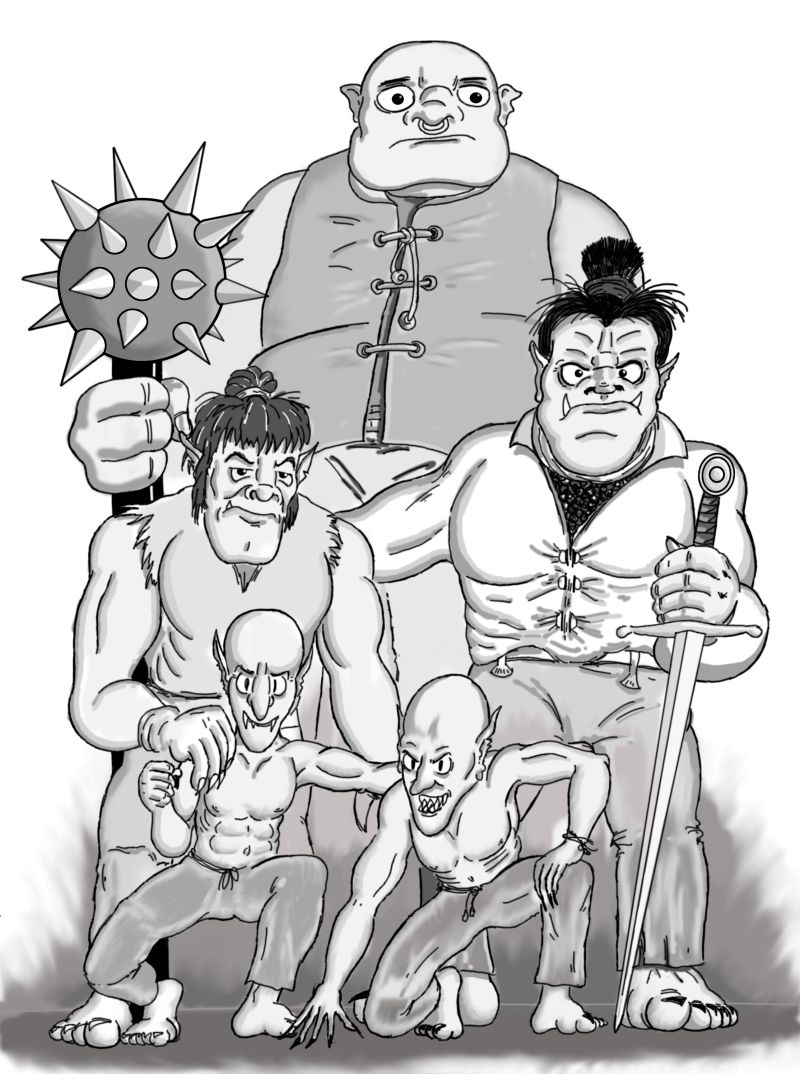
Humanoids are a big part of the adventuring culture, particularly on Barnaynia, and this is the first in a series of blogs looking at how we use these various creatures on Barnaynia. Some of the ideas are borrowed, some are based on interpretation of the original listings in AD&D, others on fables and stories by other authors, such as Tolkien and so on.
But most of it is our own interpretation – totally new and original-ish and deffo nothing to do with AI because that’s just boring. We like making up stuff like this and getting AI to do it for us is like enjoying Golf but getting a Robot to play golf for you.
Each blog will deal with a different Humanoid species, giving some interpretations on social structure, physiognomy, belief systems, reproduction, origins, relationships with other races and so on. As usual, we use the word Race to mean Species in all cases. I know that isn’t the present way of thinking, but Barnaynia doesn’t have a science of genetics yet so they have no concept of the difference. Here's what we have so far...
More may be added over time…
Originally, all the Humanoids in the monster books were pretty two-dimensional sword-fodder, but things have moved on from that – such as the “Lawful Good” Orc – and monsters have become characters in their own right. Which is great. It makes everything more interesting; from designing the dungeon, to populating it and working out the relationships in existence, to interacting with the player characters to combat and even beyond.
In many campaigns, passing monsters have evolved into bitter enemies, with NPCs growing in power with the party and the two perpetually at war. In the traditional rules, this was limited by the monster’s lack of progression, but we aim to alleviate that by offering your monsters career paths too…
Most stories and films include an arch enemy that keeps going away when beaten but not dead and then coming back to do the party down again in the sequel. Think of the White Orc in the Hobbit films, Lex Luthor, the Green Goblin, or any other arch-baddy monstrous sidekick you can think of.
As is detailed in SM1 the Players’ Guide to Dunromin, there is plenty of opportunity for Humanoids (and possibly other Monsters) to adopt character classes, if they are clever enough and have access to training, and therefore progress up levels with experience. There is also the Monster Class, which is a levelled class that allows clever monsters to simply learn to be better at what they do – it’s basically a Fighter subclass with d8 hit points and access to weapon specialisation. Such beasts may become long term, recurring enemies (the Monster Character class is dealt with in more detail after the tables below…).
Anyway, I digress. There follows the complete Barnaynian option list for Monsters with Character Classes, reproduced and updated from SM1 The Players’ Guide to Dunromin. You may note that there’s some odd options here and of course, you are free to take what you like from these ideas, or simply laugh, shake your head and go somewhere else…
Table of Statistics Rolls for Humanoids
|
Race |
Str |
% |
Int |
Wis |
Con |
Dex |
AC |
AAC |
Armour |
|
Aerohominid (Aarakokra) |
n-1 |
- |
2+3 |
n |
n |
n |
7 |
12 |
none |
|
Bugbears |
1+12 |
99 |
2+1 |
2+1 |
n+1 |
n-1 |
7 |
12 |
leather |
|
Frog Folk (Bullywug) |
n |
90 |
2+1 |
2+3 |
n |
n |
8 |
11 |
leather |
|
Gnoll |
n+1 |
99 |
2+2 |
2+1 |
n |
n |
7 |
12 |
leather |
|
Goblin, Common |
n-1 |
- |
n-2 |
n-2 |
n+1 |
n+1 |
8 |
11 |
leather |
|
Goblin, Ice |
n-1 |
- |
2+1 |
2+1 |
n+1 |
n |
8 |
11 |
furs |
|
Goblin, Shadow |
n-2 |
- |
2+6 |
n |
n |
1+12 |
~ |
~ |
none |
|
Hobgoblin |
n |
99 |
n |
1+2 |
n |
n |
8 |
11 |
stud. Leather |
|
Jibberling |
n |
80 |
2-1 |
2+1 |
n |
n |
10 |
9 |
none |
|
Kobold, Common |
n-2 |
- |
2+1 |
2+1 |
n |
n |
9 |
10 |
leather |
|
Kobold, Waste |
n-1 |
- |
2+1 |
2+1 |
n+1 |
n |
8 |
11 |
leather |
|
Kobold, Winter |
n-1 |
- |
2+1 |
2+1 |
n+1 |
n |
8 |
11 |
furs |
|
Lizardman |
n+1 |
99 |
n-2 |
n-1 |
n |
n |
5 |
14 |
none |
|
Norker |
n |
90 |
2+2 |
2+2 |
n |
n |
3 |
16 |
none |
|
Ogre |
18:79+1d20% |
99 |
n-2 |
n-2 |
n+1 |
n-1 |
7 |
12 |
Leather/ furs or skins |
|
Orc, Common |
n+1 |
80 |
n-2 |
n-2 |
n+1 |
n |
8 |
11 |
leather |
|
Orc, Deep |
n |
50 |
2+1 |
2+1 |
n |
n |
8 |
11 |
none |
|
Orc, Desert |
n |
50 |
2+2 |
2+2 |
2+6 |
n |
8 |
11 |
leather |
|
Orc, Mountain |
1+12 |
99 |
n |
2+1 |
n+1 |
n |
7 |
12 |
stud. leather |
|
Sahuagin |
2+6 |
99 |
n |
n |
n |
n |
5 |
14 |
none |
|
Greenkin (Tasloi) |
n-1 |
- |
2+1 |
2+1 |
n |
n+1 |
6 |
13 |
none |
|
Troglodyte |
n |
99 |
2-1 |
2+1 |
n |
n |
5 |
14 |
none |
We have not included every Humanoid, just the ones we think are most appropriate for this treatment. We’ve included Jibberlings in here for Stats, but they could never master any kind of class, so it’s pretty irrelevant, we just like Jibblerlings....
The numbers under the statistics represent the number of d6 to roll, and the adjustment added, so 1+2 is 1d6+2, and 1+12 is 1d6+12. Where an n is shown it means the ‘normal’ 3d6 is thrown, sometimes with an adjustment, but this adjustment can’t take an “n” styled stat over 18 or below 3. The percentage shown for strength refers to the maximum percentage attainable over 18.
The AC and AAC columns refer to what the creatures’ actual armour class is (in descending AC or ascending AAC Armour Class systems) if they have no Dex bonuses and no armour. It includes skin toughness, size and instinctive avoidance, onto which Dex bonuses are added. The armour column shows what they normally wear, and therefore, combined with the base AC (or AAC), gives the normal Armour Class listed in the Core Rules. Of course, they may have access to better weapons and armour to improve their actual Armour Class when encountered.
The To-Hit chance of the monster is most affected by its ability as a character class. Like a player, it gets the best to-hit chance of its natural hit dice or its character class and level. Thus, a 3HD creature who is a fighter would attack as a 3HD monster until its level was sufficient to give it a better chance as a Fighter. The Humanoid with levels would still be able to add any strength and/or specialisation bonuses to hit and to damage, which un-classed monsters can’t.
So, what classes can you have?
The following table is a start, with Humanoids being allowed to multi-class as well if possible. Bear in mind that the training facilities in your average Humanoid tribe are a little limited... In some races choices are further limited by their society’s organisation and culture; Shadow Goblins, for instance, are all trained as Illusionists of a sort and will only have limited Fighter style fighting ability. [Shadow Goblins are a superb monster produced by the Fiend Factory feature in White Dwarf Magazine issue 36, as is Winter Kobold.]
The hit points gained as the creatures go up levels will add to their basic hit points, but the first level replaces the highest d8 hit dice of the creature’s natural hit dice. So, a 1st level orc fighter will have 1d10 hp, whereas a 1st level bugbear fighter will have 2d8+1+1d10 hp rather than the 3d8+1 that is normal for a Bugbear.
Skills and abilities gained from their adventuring class benefits are in addition to any natural or cultural skills, although most monsters will have their Life Skills (the Barnaynian version of non-weapon proficiencies, but with more options) limited by the knowledge of their species.
Level Limitations for Monsters with Classes


WDoc refers to Witch Doctor, while WDBar is Wild Domains Barbarian, Dab is Diabolist, both new classes in SM01 The Players’ Guide to Dunromin, Necro is Necromancer, the Anti-Druid, another new class but detailed in SM02 The Gamemaster’s Guide to Dunromin.
The justification for all the details on the above table is that they are all driven by the flexible play design of Dunromin, but a few specific things are worth pointing out:
Firstly, that the Mountain or Great Orc are far superior to Half-Orcs in many ways, but Great Orcs are primarily Underworlders, only very rarely being encountered on the top side of Barnaynia. Being shaped like a flattened banana, Barnaynia has an upper and lower side. The Upper Side is where most play takes place and is most like a normal D&D landscape. The Underworld is similar but wetter and with a different set of creatures, the Humans being replaced with the Great Orcs and the Elves being more or less unknown.
In the event of a PC wanting a monster character this is probably great fun, but the GM will need to consider certain complications, such as access to weapon and Life Skill training, racial abilities beyond those detailed in the core rules and so on. The Deep Elf (Drow) is a PC option, but this would be complicated in the Land of the Young where Deep Elves are simply not tolerated by other Demi-Humans.
When PCs with a monster class were play tested the main stumbling point we discovered was access to research and training facilities, since they were generally at war with the Land of the Young by default and not citizens. But it was good fun – see SM16 The Book of Legends for an actualisation of this idea.
Or does this all sound a bit too much?
Rather than have intelligent and anthropomorphic monsters developing normal character classes, why not just have them learning to be more dangerous monsters?
The Monster Character Class: To this end you could take any Humanoid (for simplicity, but you can extend this idea) of average or better intelligence and figure out how they are able to stand out from the crowd enough to learn from their experiences in a way most of their kind do not. There are plenty of examples in popular literature and cinema and it is a probably a less controversial way of making monsters more of a threat without resorting to the above option of giving every clever Orc the chance of being a Lord or a high-level Mage.
For this to work, it is suggested you use the fighter experience point tables, a d8 for hit dice and only allow weapon specialisation after they have achieved more HD than normal. They start with their natural Hit Dice and only add more hit dice as their experience level exceeds their normal hit dice. So, a Bugbear who was clever enough would gain experience and when he had enough to become a 4th level fighter, he would gain an extra hit dice (HD 4+1); bonuses due to their Strength, Constitution and Dexterity; and start getting Fighter skills and proficiencies and Life Skills.
Likewise, the creature would use the Moster to-hit tables and saving throw tables until their Monster Level exceeded their normal Hit Dice
To clarify this, a Bugbear normally has 3d8+1 HD, so they would need to get enough XP to be a 4th level fighter before qualifying as a Monster Character Class (8001xp) as above. Then they would start using the Fighter to-hit and saving throw tables as a 4th level Fighter. When these creatures get to these levels, don’t give them the starting weapon Life Skills of a Fighter, rather give them what they would have gained from being that level (2 weapon proficiencies as 6 hit dice, for instance, as a fighter gains 1 proficiency every 3 levels).
Weapon Specialisation and Magical weapons would add to their chances to hit as well, making them even more useful. Also add Dexterity bonuses to hit with missile weapons and Constitution bonuses to hit points should be added as per Fighters.
One should add the strength damage bonuses at all levels. Use the tables above to determine their strength and apply the damage bonus to the normal weapon damage or a bit bigger if the weapon is bigger. For instance, a Hill Giant with 19 Strength would get +7 to damage. They are listed as doing 2-16 points damage in the core rules but for a Monster classed Hill Giant you could say their huge clubs do 1d10 or even 1d12 damage base, add their strength bonus would give a starting Monster Hill Giant the same stats as a normal Hill giant but with an extra Hit Dice, with +3 to hit due to strength and doing 1d12+7 damage per hit. If the same Hill Giant makes it up three levels as a monster (10HD) then he gets another weapon proficiency slot. If he chooses to spend this on club, he will become a club specialist and would then be attacking as a 10HD monster with +4 to hit, +9 to damage and attacking twice a round (Fighters increase their rate of attack at seventh level). Another 3 or 4 levels and he could double specialise, so his main attack is now as 11 or 12HD monster with +6 to hit and damage of 1d12+10. In this way specific individual monsters can become fearsome opponents without having to resort to up-gunning every member of the species.
In order for these creatures to progress in this fashion they should be exceptional in some way, probably Intelligence or Wisdom, or born to it through some tribal tradition such as being royalty or the equivalent. The justification for all this is based on making normal monsters more of a challenge to the party. If they are already, then don’t include this rule as you may find the monsters beating the party too easily. As with all such things, it’s just an idea and the GM can balance it how they like.
This is all partly inspired by our friend John Sewell and his interesting interpretation of the Shuzgrap bugbear when he ran TSR’s “Dwellers of the Forbidden City” for us. John’s use of Shuzgrap as a seemingly indestructible political wannabe king was highly entertaining and spawned many similar characters, both competent and not-so, in other campaigns. It was a revolutionary new idea then, in about 1982; we were only about 14.
Other monsters can have non-monster classes too, if they’re clever enough. Certain Undead, like Vampires and possibly Lichs, could retain all the memories and skills of their former life, as well as their spell abilities. And likewise, creatures like Ogre Mage might have some character class-like skills
So, what are “Giantkin”?
This is a term used in many reference books and is described reasonably well in the original AD&D 1st edition PHB, although that was before many of the Humanoid species were created. On Barnaynia, the classification of Giantkin refers to two basic groups:
- Giants and their immediate relatives, including Trolls, and;
- Non-human, mammalian hominids, excluding “demi-Humans”. This includes, but is not limited to, Orcs, Goblins, Hobgoblins, Bugbears, Gnorkers, Ogres (not Ogre Magi) and so on. It does NOT include Kobolds, Lizardmen or other reptiles, nor amphibians, birds or fish.
© Dunromin University Press
If you found this item useful/interesting/fun then you might be interested in our other articles about Humanoids:
Goblins here
Orcs here
Kobolds here
Lizardmen here
Hobgoblins here
Gnolls here
More may be added over time…