


Of Goblins
Dated: 27 Aug, 2026
This is the latest in a series of Blog Posts about Humanoids on Barnaynia. While these thoughts need have no real effect on your game, they are here as food for thought, if nothing else….
Goblins have been a favourite of ours for many years, and of others if Terry Pratchett’s and other books are anything to go by. We featured them in the adventure SM07 The Warren, exploring their fiendishness and ability to organise (or be organised) that comes from their Lawful Evil nature (as opposed to Chaotic Evil). This led to comparisons with Tucker’s Kobolds, which is fair, but we think we did it better, by which I mean we did it nastier…
Physical Appearance (and breeds)
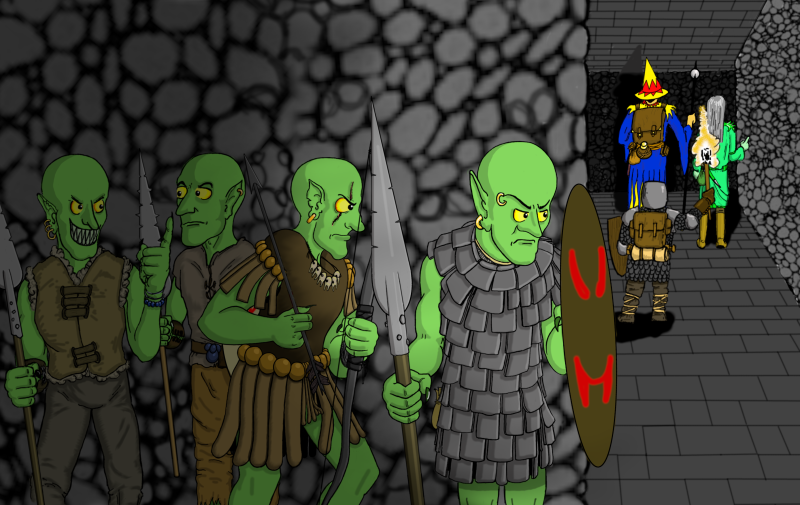
Goblins are short, averaging 3-feet tall, and skinny, with proportionally longer arms and shorter legs than Humans. Their gait is slightly stooped but still rapid and quiet. Facially they have elongated faces with bulbous chins, noses and ears. The skull has a wide, long jaw with a small cranium gauged with humans, but not as small as monkeys. Eyes are green, grey or pale blue, occasionally yellow or pale pink, and they all have Infravision. The forehead recedes and the head and shoulders often have sparse, dark hair. Colouration is green to pale green or grey. Fingers are long and nimble, feet wide and calloused. They walk on their hind legs at all times and can climb and swim well.
Their language is guttural with snorts and squeaks, often quite hushed as they are used to living in environments where sound travels far. In the areas around the Land of the Young the Goblin language is referred to as Grunt 1 and is shared with Orcs and Hobgoblins. Further away they have many other languages and communication forms. Intelligence is lower than Humans on average but with an animal cunning and some individuals display exceptional Intelligence.
There are many breeds across the world, but their physical characteristics are the same, save for some pigment variation. The exception is the Ice Goblins who are greyer, more thick set, walk more upright and are not affected by sunlight. Ice Goblins have more hair across their shoulders and chests as well as the back of their arms. Their eyes are more often blue than green
Geography and Habitat
Being uncomfortable in sunlight, Goblins are a subterranean species and their populations are limited by having to avoid sunlight. They can be found in cave systems across the world, but are most common in temperate and colder climates, preferring hills and mountains or deep forests. They are also to be found in the Shadowlands but this is more likely to be the Ice Goblin breed, using wind-powered sledges rather than their more usual Long Ships. Ice Goblins are also common across all the cold oceans of the west end of the Upper World, sailing about to trade and raid as suits them. Goblins can also be found on the Under World but not in such numbers, apparently disliking the damper atmosphere.
Diet
Goblins are omnivorous and will eat pretty much anything. Like Orcs they have digestive systems to rival a Vulture and will happily eat rotten meat and carrion as well as all kinds of mushrooms, Thaumofunghi and vegetables. They seem particularly fond of small fruit and berries, even species considered toxic to humans.
They actively hunt large prey, acting in coordinated hunting groups, using weapons, snares, pits and other simple tactics. They are well organised cooperate efficiently in these tasks. Most Goblins are highly skilled in tracking (in their local environment), hunting and processing the meat, skin and other product they find. Goblins are good leather workers.
Goblins prefer to have a central base to operate from, usually in a well-protected cave system and are not usually nomadic. They are good tunnellers, but not on the same level as Orcs or Dwarves. A base will be a multitude of inter-connected caves with small communications tunnels. Outer areas will be guarded and trapped in whatever way they can. If a base becomes established Goblins will farm Thaumofungus and breed rats, dogs, Deep Chickens (Towok) and cave-goats (Guttig). Goblins can also farm pigs if they can get them, or anything else they can eat.
Alignment Preferences
Goblin society is Lawful Evil in nature, Lawful Nasty in Barnaynian Terms, although individuals vary considerably around this norm. They will always act honourably to other Goblins, regardless of tribe. War between Goblin factions is surprisingly rare, with disputes usually resolved by compromise or individual combat. There are many reports of Goblins demonstrating Good (Nice) behaviour to their own kind and even to others who treat them well, but to call them “trustworthy” is naïve under any circumstances.
All such apparently loyalty is (almost) always a sham. Their first loyalty is to the clan, the second is to themselves, they have no other loyalties. This means they put the clan’s welfare above their own, which could be mistaken for noble self-sacrifice. Even when in the thrall of a higher power, Goblins will always be on the look-out for weakness and the means to exploit it. Managing Goblins as an ally or as a slave force or anything in between calls for strict adherence to cruel measures and absolute consistency. They will exploit any opportunity to better their clan’s position and any Goblin demonstrating behaviour that favours someone outside of the clan will be a purely pragmatic act of self-preservation.
Social Structure
While Goblin clans are patriarchal, following a chief who will have demonstrated martial prowess, the social structure revolves around the dominant females. The more powerful a Goblin female is, the more lovers she will have. All Goblins are very promiscuous and will have young with several partners. This is the core of the Goblin philosophy of siblinghood; that is that most Goblins do not know who their father was and therefore any Goblin from anywhere might be a half-sibling. In a similar fashion, while Goblins retain a strong tie with their mother, all the females in the clan and most of the males will be involved in caring for the young, including feeding them.
There is little distinction between the sexes, with both males and females being warriors, although female chieftains are very rare. This generates a tight clan bond and welcoming and friendly disposition to other clans. The wider diplomatic links between clans are strengthened whenever two clans get together as a considerable amount of mating at all societal levels will take place in rather orgiastic rituals.
Older Goblins are respected for their knowledge, although it is thought shameful to not be able to breed any more. As a result, older Goblins will often “lose themselves” and wander off in dangerous passages, or engage in suicidal combats, so as not to embarrass their offspring.
Religion and Spirituality
Goblin spirituality varies a lot across the world. They seem to adopt whatever gods or belief systems that are held by whichever masters they happen to be working for, adopting religious practices quickly and without protest. This, like so many of the actions of Goblins, is a façade. Each clan and group of clans will have deep beliefs in specific cults formed in Goblin Lore. All of these cults contain spirits or gods of varied names but pretty consistent characters and powers. All of them are deceitful but suicidally loyal to their mothers, although female spirits seem to be of a lower caste then the five main, male gods. These five entities are, in no particular order as the hierarchy varies from clan to clan, deceit and family, deceit and fertility, deceit in war and hunting, deceit and having fun, and pure deceit. It should be remembered that these are all about deceiving others; non-Goblins or, in rare cases, other Goblin clans. Deceiving a member of your own clan is simply not acceptable.
Reproduction and Family
Goblins are mammalian and give birth to litters of 1 to 4 tiny babies, who are suckled for several months. Goblin young are able to walk within 3-4 months and become dangerous over the age of 2, by which time they are usually about 2-feet tall. Goblins also breed quickly, with a healthy female able to produce 2 litters a year, but with only about 40% of the offspring surviving to maturity, at 7 years old. Goblin children are called Gobbers or Goubers.
As has been said, childcare is shared throughout the tribe forming very strong familial links. The most fertile females will inhabit the positions of power and will be consulted by the chief on important matters. The clan or tribe is essentially one big family with knowledge of the maternal line for each Goblin being a matter of pride and religious significance.
Goblin naming traditions vary a lot, but the most common style involves a clan name and an individual name or description, which is given at the age of about 7. Prior to this the Goblin will have a “Gouber” name, which is one of several recycled names that are evolutions of their mother’s name. The adult name might be an interesting sound, a description of something they did or a description of a physical difference, e.g. Grarg, Elf-stabber or Spotted Ear.
Clans will often have a number of names. They will have a preferred, exaggerated name describing their history, desires of traits, while they will refer to themselves by a shortened version of this or something completely different. Goblins often have different names for other clans as well, the reasons for this are unclear but probably rude.
Weapons, Armour and Equipment
Goblin technology varies widely. Some breeds, particularly around the Land of the Young, seem extremely cunning when it comes to fashioning weapons and tools from the resources they find around them. Anything they capture or steal will be adapted to their use, blades of all kinds being particularly valued.
All Goblins will have a small knife, as a matter of personal pride, but will also have a selection of personal or shared weapons. Spears, short-bows and various short swords and long knives and daggers being most common. They are known to use hand-axes in combat but prefer stabbing and slashing weapons to anything that requires strength, such as blunt weapons.
Bronze if their material of choice for weapons and armour. There have been no reports of Goblins ever smelting their own iron, but this does not mean it doesn’t happen. Given their natural cunning and adaptability, it seems unlikely that they have not managed to obtain iron from iron ore, but if they have it must be on a small scale and poorly done. They certainly have no knowledge of steel. If all else fails most tribes can work flint and other stone, as well as manufacturing short-bows and spears with Thaumofunghi, flint, bronze or some other sharp material.
Goblins often use shields of various designs, but rarely large ones as they prize mobility over defence. To this end, Goblin clothes are usually light and designed for protection and concealment rather than modesty. Armour will be light and flexible, and shoes and helmets are rare.
They like chainmail, when they can get it, but their own attempts to copy it are clumsy and only of limited use. While more sophisticated armour is beyond their ability and patience, they will happily use whatever they can steal although it is rare they will ever find anything that actually fits them.
Tools, traps, homes and hunting equipment will be primitive but effective, making the best use of the resources around them. Goblins will often wear trinkets and trophies, and such items are often tokens exchanged during their rather short and hectic mating rituals. They value gold and silver, as they know it is useful to trade and bribe enemies, and particularly value gems with good cutting edges. Such loot will be associated with rank but is also seen as belonging to the whole tribe, although usually looked after by the chief.
Special Tactics and Strategies
Goblins are masters of hit and run tactics, using their small size to elude attackers within narrow tunnels and such. Missile weapons, arrows, darts and spears, will be used as much as possible to lure enemies into traps or away from the lair. Anyone moving close to a lair is likely to be watched and stalked rather than attacked openly, unless necessary. Once a danger has passed, the tribe will then plan a suitable ambush if they think they can win and the enemy has something they want.
Goblins are very much aware they are at the bottom of the food chain in the dungeon and will go to extraordinary lengths to get the monsters in their locality on their side. Even if the monsters cannot be reasoned with, the Goblins will construct their lairs such that wanderers are steered away from them and towards more dangerous neighbours.
Being small, Goblins have a good selection of possible mounts, favouring Wolves and, when they can get them, Wargs. They make unimpressive cavalry but can use bows and spears from wolf-back to great effect. Smaller adult Goblins are valued by the clan as fast messengers.
They use sheep and goats as beasts of burden but do not use mules, donkeys or any other horse as anything but food.
© Dunromin University Press
If you found this item useful/interesting/fun then you might be interested in our other articles about Humanoids:
Orcs here
Kobolds here
Lizardmen here
Hobgoblins here
Gnolls here
More may be added over time…