


Of Kobolds
Dated: 27 Aug, 2026
This is the latest in a series of Blog Posts about Humanoids on Barnaynia. While these thoughts need have no real effect on your game, they are here as food for thought, if nothing else….
Physical Appearance (and breeds)
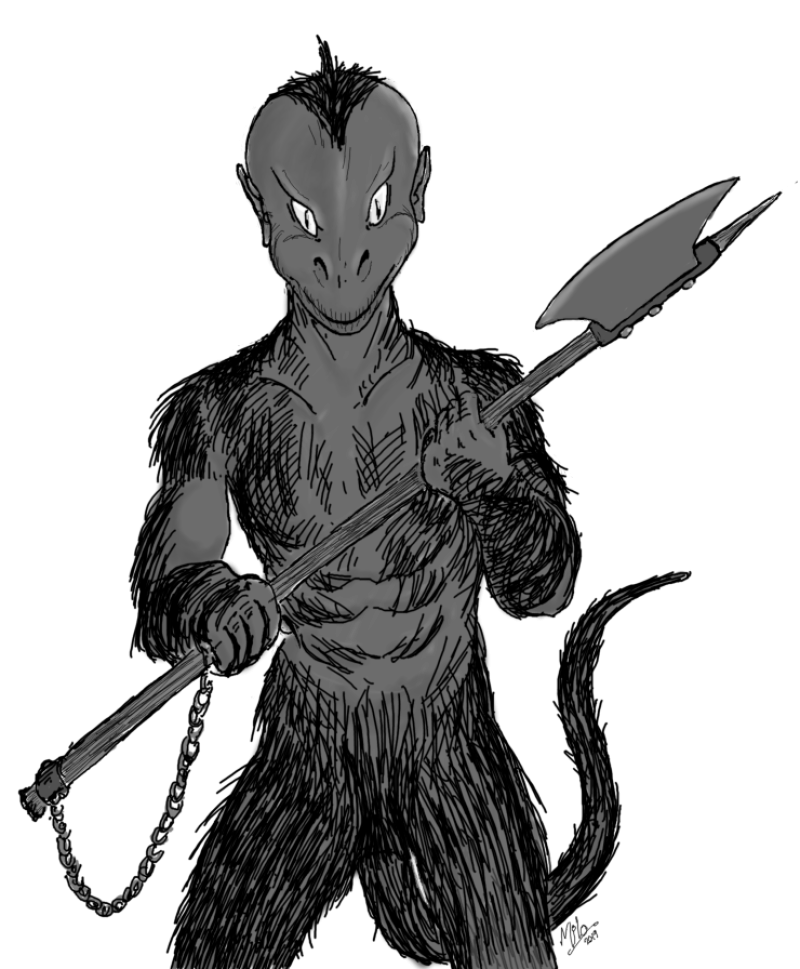
Kobolds resemble hairy, bipedal lizards with some dog-like characteristics. They are rarely more than 3 feet tall, thin and have flexible tails. Colouration is grey, green, occasionally light blue or pale pink. They are covered with dry scales, but wiry, dark hair grows between these plates and they are warm blooded. Suggestions they are related to lizards or dragons or even wolves have never been satisfactorily resolved.
The link with Dragons, somehow, is more likely as Kobolds are able to Thaumosynthesise to a small extent; that is derive some of their nutrition from absorbing the local magical fields. This not sufficient for them to survive on it but is enough to reduce their protein intake to starvation levels and survive.
The Kobold face is narrow and dog-like with forwards facing eyes and large ears, all covered with threadbare fur. They have no nose but slit-like nostrils on the side of their snouts. Many have crests, fins or flanges on the head or down the spine but these don’t seem to have any social or breeding significance, and don’t seem to be inherited, just a random mutation. Teeth are even and regular, like a lizards, but with pronounced canines. Males and Females are essentially indistinguishable except when heavily pregnant.
Winter Kobolds are merely normal Kobolds with thicker fur and a paler, usually white colouration. They tend to be slightly larger with more fat on their limbs. Some say they are smarter than normal Kobolds, but this is difficult to quantify.
Waste Kobolds are also not significantly different to other breeds, save their skin colouration is pale brown and their fur is longer but sparser. They are definitely cleverer than normal Kobolds and demonstrate cunning tactics tracking victims in the desert wastes. Waste Kobolds are also able to survive longer without water and seem more comfortable in daylight than other breeds, although none suffer penalties in sunlight like Goblins and Orcs.
There is thought to be a Jungle breed of Kobold as well, but these seem to be identical to normal Kobolds except that they have predominantly darker green scales and less hair.
Geography and Habitat
Kobolds are found pretty much everywhere across the world, with only the Shadowlands being relatively free of them, but even then not completely. They seem to be very adaptable to climates and ecologies of all kinds. They are capable of rapid reproduction when conditions are good. They often insinuate themselves into much more powerful civilisations as slaves and servants and then become very, very numerous.
Deep Elves, in particular, tolerate them despite regarding them as vermin. In this case the Kobolds’ saving grace is that, if properly cooked, the Deep Elves find them quite agreeable to eat. It is likely that other species would like them too, if they tried them.
Kobolds are particularly common in the Empire of the Great Orc, for all these reasons. Great Orcs use them as slaves for all menial tasks and eat them as well. Other races of Orc prefer Goblins as servants.
Explorers report that Kobolds are all but unknown in the deep Darkworld, but this is probably due to the other creatures living down there hunting them to extinction.
Unlike Goblins, Kobold are poor communicators and have never been good merchants. Nor are they particularly gifted with languages, some examples being barely able to master their own language, which is called Klutss in the Land of the Young. If kept fed and rewarded they make competent servants but poor soldiers as their tactics, loyalty and organisation are poor to non-existent.
Diet
Kobolds are carnivores and insectivores but can also survive on certain types of soft Thaumofungus. Being Thaumovores as well they can survive on a very low calorific intake of “real” food, but they still need protein to eat regularly. Their digestive systems are not as tough as Goblins nor Orcs, so they need reasonably fresh meat. They don’t seem to like cooked meat but will otherwise eat anything, including grubs and insects, some Thaumofungus, Fungus, shellfish, fish and birds. They cannot eat vegetables nor fruits.
Some clever Kobolds have managed to grow Thaumofungus to supply their own needs but generally the existence of nutritious species of Thaumofungus in a Kobold lair is either coincidence or the reason why the lair was established there in the first place.
Kobolds don’t seem to have embraced any kind of cooking or mixing of ingredients to make better food.
They use certain Thaumofungi as intoxicants and are vulnerable to becoming addicted to a substance called Klack. This is a Thaumofungal concoction that gives Kobolds a warm and rushing high but gradually destroys their motor neurons over time. See SM10 The Pit of Panza for more information on Klack.
Alignment Preferences
Kobolds are Chaotic Evil, Chaotic Nasty in the Dunromin system, with the emphasis very much on the Chaotic rather than pure evil. Most individuals have a very nasty inclination and would certainly hit a foe while they were down or take advantage of them in any other way. Many are, however, neutral in their attitude to non-Kobolds. They are survivors first and foremost and will sacrifice anything, including their own family, to get away from a threat.
Any semblance of teamwork in the way they fight or behave will be pure pragmatism. It takes a determined and gifted leader to get any kind of organisation out of a group of Kobolds. Their attitude to tribal behaviour such as fighting as a group is primarily driven by the realisation that all the alternatives are worse.
Social Structure
Kobold society has a very flat structure based around a few strong or intelligent individuals, possibly a Shamen, or a single strong personality. The leader, or “chief” for lack of a better term, is usually the best fighter but that isn’t always the reason why they are leader. Pretty much every other member of the tribe, male and female, is of the same rank and there is no familial format nor any great tie between parent and specific offspring. A typical example of a small Kobold Tribe can be found in SM12 The Trials of a Young Wizard.
Religion and Spirituality
Many researchers claim that Kobolds worship a great Kobold called Kurtulmak. Shrines to some great Kobold being are certainly a feature of most lairs and sacrifices are made to effigies of the being. There are stories regarding the deeds of this hero and its occasional direct interference with the lives of Kobolds or their enemies. Quite how this relates to the everyday existence of an average Kobold is not clear.
Kobolds do not seem to be particularly spiritual and the worship of Kurtulmak is an act of desperation rather than any specific religious inclination.
Reproduction and Family
Kobold females lay clutches of 2-8 large, leathery eggs which double in size, by Thaumosynthesis, and then hatch in about 4 weeks. There will always be at least one room in a lair where soft sand is collected for the incubation of the eggs and, although this chamber is usually warmer than the rest of the lair, there doesn’t seem to be any requirement for warming or turning of the eggs. Some tribes bury their eggs in the soft sand, others just lay the eggs on the top.
The mother will then take no interest in the eggs. Kobolds seem not to take any delight in the reproductive process as other species do, but rather go unquestioningly through the motions on the basis of instinct alone.
When the eggs hatch the young will already be pretty independent. They are then gathered by elderly kobolds assigned to childcare and fed and taught what they need to know. At the age of about 4 they are big enough to become part of the main tribe.
The older kobolds that are tasked with looking after the young do not seem to be particularly attached to their charges nor very proactive in their jobs. It is likely that these individuals are the less able warriors or the least intelligent of the tribe, acting purely on the expectations of the group without the wherewithal to question the assignment.
Weapons, Armour and Equipment
Kobold technology is rudimentary at best. Weapons will usually be flint-based or stolen. There is no record of them using anything resembling smithing skills and certainly they seem to have no concept of tools beyond the simplest scrapers, needles, flint blades and such. Spears and stolen weapons are about the peak of their invention. They can learn to use bows but prefer spears and darts for missiles and melee. Axes are popular, stone if metal ones can’t be obtained.
The use of simple shields made of stretched hide is widespread, but Kobolds seem unaware of the utility of armour or clothes. Even fire and its use to warm a lair is a rare innovation.
Special Tactics and Strategies
Some describe Kobolds as “cunning” but this is an animal cunning with more in common with the guile of a fox than any greater reasoning, like a Goblin for instance. Combat tends to be mob rule, based on numbers being used to overwhelm or confuse their enemies. Running fights, pit traps, tripwires and ambushes are about the height of their strategic resources. Kobolds are clever only insofar as they can see when they are beaten and will flee without thought to their companions.
Being stealthy and sly they do have some utility as scouts and spies, but they are hardly reliable ones. It would be a very unusually intelligent Kobold to be of any use to any kind of modern fighting force.
© Dunromin University Press
If you found this item useful/interesting/fun then you might be interested in our other articles about Humanoids:
Goblins here
Orcs here
Kobolds here
Lizardmen here
Hobgoblins here
Gnolls here
More may be added over time…