

Of Orcs
Dated: 27 Aug, 2026
This is the latest in a series of Blog Posts about Humanoids on Barnaynia. While these thoughts need have no real effect on your game, they are here as food for thought, if nothing else….
Physical Appearance (and breeds)
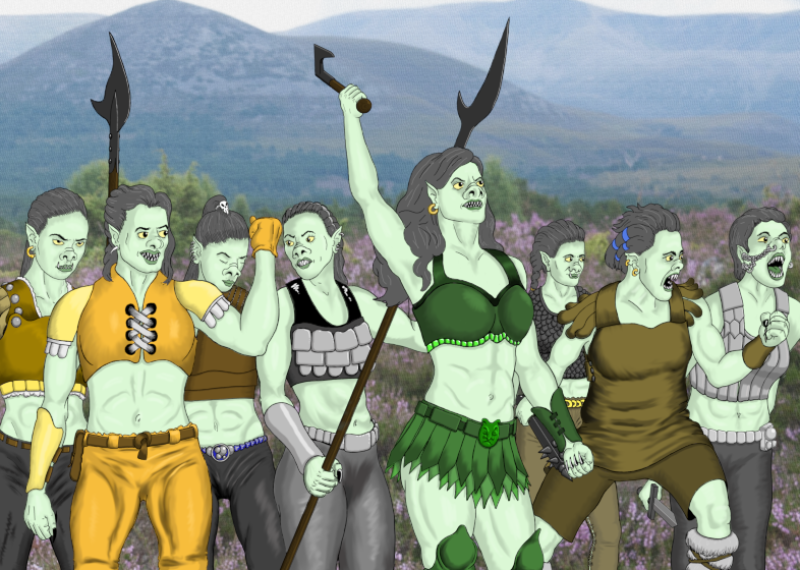
The face of the Barnaynian Orc varies from a narrow, crushed face with upturned, wide nostrils, resembling a pig, to broader, flattened faces with squashed, rounded noses. All have pronounced canines and sharp incisors, with minimal molars and no pre-molars.
Ears are pointed buy vary in size from small, stunted shapes to large, flappy ones. Eyes a small and pig-like, with large pupils and dark green or grey irises. Hair is uniformly black and straight, thicker on the body than the head. Skin tones vary from pale grey green to light grey and on to dark grey and even black, many are speckled or piebald with different colours on the torso.
All Orcs have Infravision and a deep sensitivity to, and distrust of, bright lights. Their hearing and sense of smell is generally similar to Humans, but some individuals often develop very sensitive noses.
The typical Orc is similar in build and size to a lean human, but with broader shoulders and less hair on their heads. Most orcs have hairy upper bodies, some are hairless. Some tribes shave or style hair in a uniform manner or even colour it. Tattoos and face painting are common, indicating tribal loyalties and personal success.
Due to the nature of their civilisation, most Orcs are underfed and stunted in growth. A well-fed Orc will usually grow taller and more muscular than a human, even reaching 7ft tall on occasion. Orcs who came to better food later in life tend to grow considerable paunches and this is seen as a sign of status.
There is little difference between male and female Orcs other than the reproductive organs and the females usually having wider hips and thicker thighs. All will function as warriors and have similar skill sets.
The Common Orc, also called the Uruk, conforms with this description but varies in pigmentation and certain physiological characteristics across the world. Orcs of the far east will usually have a mottled pigmentation and large lower canines, those of the far west are hairier with smaller ears and eyes.
Desert Orcs are very similar to Common Orcs, and the physical differences are barely noticeable amongst the variation in the common types. The main difference is the skin colour, which for Desert Orcs is jet-black, but might be gloss or matt in lustre. Other differences are of societal behaviour, lack of a fear of sunlight and a skinnier frame. Desert Orcs also have a much greater Constitution and can bare the privations of their preferred habitat better.
Deep Orcs are usually the same height as normal Orcs but will be more bent over, crouched or even gambolling along on all-fours. They are hairless and their skins are almost entirely white or very light grey. Their eyes are white or pink, and they rarely wear clothes other than belts of harnesses to carry their tools and weapons.
The Great Orcs are a race of Common Orc that has been exposed to a healthy diet and selective breeding for millennia. The result is a taller, stronger and generally more dangerous Orc. Great Orcs are between 6 and 7 feet tall with powerful limbs and lots of muscle-tone. Their heads are rounder with sloped foreheads, squashed noses and wide, bright eyes. Eyes colour is metallic blue to dark grey, hair is black and thicker on the head, although receding from an early age.
All breeds of Orc can reproduce with each other but generally chose not to. The Common Orcs around the Land of the Young all seem to speak the language known as Grunt 1, or just Grunt, shared with Goblins and Hobgoblins. Many Orcs will know several other subterranean languages and the Orcish skill with learning new languages is legendary, matching Elves in this ability.
Great Orcs do not seem to have this skill with languages or chose not to use it out of their elitist temperament. Whatever the reason, they all speak the Fessel-Bark, or “High Speech” if translated to Common. This resembles Grunt in sound but is a wholly different form of language. Both Fessel-Bark and Grunt have written forms, but they are also very different.
Geography and Habitat
Common Orcs are as widespread as Humans and as common across the Darkworld as Humans are on the surface. They are not so common in the Shadowlands and generally avoid arctic and sub-arctic areas. They live exclusively underground or in fortresses on the surface that replicate the deep earth inside. They are excellent miners and builders and some tribes match Dwarves in their stone craft. Many Orcs are skilled workers of metal and other crafts as well, but tribes jealously guard their skills and knowledge so that Orcs in one location might have a vastly different set of technologies to even close neighbours.
Common Orcs seem to prefer cave systems beneath fertile lands and forests, while Desert Orcs rarely stray beyond those cave systems that lie under the deserts, although all Orcs can be found at almost any depth within the vast labyrinth that is the Darkworld.
Common Orcs are great travellers and traders, forming the mainstay of the mercantile classes of the Darkworld, along with the Drow. As a result, Orc culture is rich and diverse, different clans taking a perverse pride in adopting customs and habits at odds with their neighbours.
Deep Orcs, in contrast, rarely travel and can only be found in the deepest parts of the Darkworld, scratching an existence from the strange creatures that are their neighbours. They can be found in most parts of the world but never in any great numbers.
The Great Orcs seem to only inhabit the Empire of the Orc in the western, temperate parts of the Underworld. Here they have built fortress cities above and below ground and are locked in perpetual war with one another. There are no recorded sightings of Great Orcs on the Upperworld or even in the areas of the Darkworld away from the Empire. They seem to despise any kind of interaction with other species and are extremely elitist in their xenophobia.
Diet
Orcs are omnivorous and have incredibly robust digestive systems. This enables them to stomach carrion and species of Thaumofungi, fungi and plant that would incapacitate or even kill a Human. They will eat almost anything but prefer fresh, usually raw meat, even resorting to cannibalism.
Despite the popular impressions, Orcs are also excellent farmers, every tribe having Thaumofungus farms of great variety and profundity. They also process food for bread and ale, even varieties of wine and more exotic foodstuffs. Chefs are prized individuals amongst Orc society, being on a par with Witch Doctors and Mages in social hierarchies.
The staples of travelling Orcs are the Black Wine and the Maggoty Bread. The wine is a powerful stimulant, allowing the drinker to increase their stamina and pain tolerance to promote faster travel and better fighting capabilities. Maggoty Bread is a Thaumofungi-based baked loaf infused with maggots, weevils and other protein sources, often flavoured with spices, dried fruit or similar. This is a remarkably invigorating foodstuff, although not to Human taste, that lasts a long time, once stale, and is the Orc equivalent of Human bread.
Alignment Preferences
Common Orcs and Great Orcs are Lawful Evil (Lawful Nasty in Barnaynian terms) and vary little as individuals from this archetype due to their upbringing. The core values of every Orc community are hierarchy, pride and fear, enforced by strict rules and violence. Weakness is seen as demonstrating fear, empathy, mercy, generosity, favouritism or kindness, all of which are equally shameful.
Everything Orcs have is at the whim of their masters and treasure (and, in the case of Great Orcs, slaves) are symbols of hierarchy, power and success. Any treasure will flow upwards through the chain of command based on bullying and exploitation. Wealth, equipment and girth are marks of success amongst Common Orcs.
The myth of the Lawful Good Orc was tested in recent years when a Half-Orc, a daughter of Baron Illmere, converted an Orc Prince and about a third of his tribe to the worship of Athena. They found an ally in Baron Garibaldi, and he permitted them to establish a settlement on his western border, in the valley of the Ruined River. Alas, for the purposes of Scientific enquiry, when the local Dwarves of the Blue Mountains found out they fell upon the settlement and slaughtered them all. This caused some diplomatic friction for quite a while and ruined any chance of us finding out if a colony of Lawful Good (Lawful Nice) is at all viable.
Deep Orcs are uniformly Chaotic Evil (Chaotic Nasty) and are selfish, cruel and obsessed with violence of every kind. If there is any variation within this generalisation it is yet to make itself known to civilised society, even in legend.
Social Structure
The Social Hierarchy is the dominating influence on every Orc society, based purely on combat proficiency. Every individual is subservient to everyone senior to them, a cruel bully to everyone below and constantly in conflict to establish superiority with their peers. The society is mainly Patriarchal, but this is due to the slightly physically stronger nature of the male. Females can aspire to any social rank they can achieve, and daughters are as vital as sons to the parents.
Every tribe will have a Chieftain, sometimes called King, Prince, Duke or Karg. Below them will be their family, the religious and magical members of the tribe, as well as the chefs, then the best fighters below them. The strongest warriors will have the positions of power, such as bodyguards and officers. Rank is achieved by physical prowess, although intelligence, or at least cunning, is an important part as well. Power is then distributed by force of arms down through the tribe to the weakest and oldest, who get the most menial tasks and worst treatment.
The Great Orcs take this blueprint of physical domination to a vast and sinister extreme. The Great Orcs are ruled by an Emperor from a huge fortress-Palace somewhere in the Underside of the world. He devolved his power through several high-ranked Great Orcs, called Shoguns, and then a cascade of Warlord aristocrats down to petty nobles. All these individuals command armies and are constantly at war with one another, forming alliances and betrayals. These armies are staffed by lower status Great Orcs but also contain many Common Orcs and other species.
In place of fear and intimidation, this structure is founded on a concept of Honour of a kind with, but entirely different to, the feudal Japan of Earth. It is more like the corruption of the Bushido code that was prevalent in WW2 than the true code from the 18 and 19th centuries. In truth, little is known of the intricacies of this system at the University of Dunromin as the Great Orc Empire is as intolerant of foreigners as it is entirely obsessed with its own internal struggles. It is thought that the sheer cost of remaining in a state of almost total war has prevented any Great Orc with the inclination to explore beyond their current boundaries. This self-destructive perpetuity has been going on for at least 500 years, probably longer. It is anyone’s guess how long it can be sustained.
More information about Great Orc society can be found in SM19 The Beasts of Barnaynia, SM05 the World Guide to Barnaynia or SM02 the Gamemaster’s Guide to Dunromin.
Religion and Spirituality
Orcs have many gods, most of them violent. Anyone studying the plethora of creatures in the Orcish pantheon will soon discover that many of these entities are the same creature going under different names and with different appearances and/or powers. Gruumsh is the most well-known of these, also referred to as “the Beater of the Drum” and usually manifest as a very powerful Orc with a single eye. Variations have red skin, many eyes or no eyes. Gruumsh’s Drum is a significant and powerful symbol amongst the Orcs, the Drum being a vital part of the main Orc creation myth. The True Drum is not Gruumsh’s to own, he is merely a custodian.
The Moon as a deity is present in a number of manifestations with a lot of names but usually with the title “Spirit of the Moon”. All such entities are powerful magical creatures, rarely Orcish in appearance but always with a vested interest in Orcish prosperity. It is this entity that many Mages have impersonated to fill their Orc armies with fear and fanaticism. It doesn’t always work.
Gichark of the Blade Lore represents weapons and their fabrication, care and maintenance. Gichark is also a title or compliment, meaning “gifted in Blade Lore”, and is the name given to legendary blades as well. Gichark is supposed to have made 12 great blades and gifted them to the original 12 Tribes of the Orcs. His sign is a red skull.
Like many subterranean races, the fungoid creature Fu’Nithiln features as a provider deity, blessing clever farmers with bumper harvests of Thaumofunghi.
All of these and other deities feature strongly in the lives of all Orcs save the Deep Orcs. Every Orc will carry a token of one or more of these and other patrons, every tribe will have a Great Drum to use in battle to rally the troops. Religious ceremonies will be enacted before any major undertaking and sacrifices, usually blood sacrifices, are a common element of every ceremony. The blood might be a hapless victim and/or offerings from the Orcs themselves.
Reproduction and Family
Orcs are mammals and the females give birth to a single Urukling, roughly every year for the fertile period of their lives, which is from the age of 10 to late thirties. Twins that survive are very rare. Adulthood is recognised at 12-14, but infant mortality rates are very high, varying between 30-80%. This is mainly because child-rearing is left mainly to older siblings and the other young in the tribe. This in turn means that the older, larger children exploit, bully and mistreat the younger ones in every way. Imagine the Lord of the Flies but twenty times worse. This perpetuation of pointless cruelty is the damage that perpetuates the nature of the adult Orc – cruelty is all that they have ever known. Superiors are to be feared; inferiors are to be exploited.
When they mature, Orcs are put into Gangs, Squads or Cadres, of 6 to 10 individuals. One of these, usually the cleverest but never the strongest, will be put in charge of the others. They will then be given a set of tasks, usually sentry duties, and left to their own devices. Such a group will quickly be riven by internal struggles for power and authority, likely ending in a fight. Thus, the most ruthless and able warriors will rise to the top and the weaker individuals killed. This terrifying initiation into adult life is common and the dead will be fed to war beasts or even the rest of the tribe. Nothing will be wasted.
The strange irony here is that Orcs mate for life, with partners selecting each other in great annual celebrations and remaining together and close thereafter, although any affection is well-hidden and any expression of love absent completely. The prodigy of their coupling is then kept until weening and then passed over to the older children. Orcs will generally be aware of whom their parents are but rarely particularly attached to them.
Senior Orcs, particularly chieftains, will have a “wife” or favoured mate, but the widows of the tribe are expected to breed with chiefs and subchiefs as well to keep the population topped up. Widowed Orcs of breeding age will form a hareem for the chief and subchiefs based on their own status within the tribe, even if they were chiefs or subchiefs themselves. This is not a lowly position but one that is respected and important. The children of senior Orcs tend to be treated slightly better, and the children of the favourite “wife” alone will be treated with any kind of patience or respect.
Warring tribes will exploit captured Orcs as they see fit. Wars between tribes are rarely respectful and behaviours we would class as war-crimes are very much the norm.
Weapons, Armour and Equipment
Deep Orcs seem to be the least able when it comes to manufacture and the use of tools and weapons. They’re entirely equipped with stolen items or crude flint or obsidian blades. Deep Orc lairs have no indication of industry and only the most primitive farming techniques, if any.
The quality of Common Orc manufacturing varies vastly but every tribe will have a faction of competent individuals capable of working metal and wood (or its Thaumofunghi equivalent). In the lowliest tribe this may be a furnace for smithing and a collection of competent bowyers and fletchers. The highest, most organised and advanced armies will have travelling smiths and weapon-makers with the army and furnaces and smelting works at their base capable of churning our reasonable pig iron. Some tribes have developed or stolen steel-making technologies, but these are jealously guarded secrets, even within the tribe.
Weapon manufacture tends to be focused on items that require minimal time and resources to produce, as well as being practical for use in close tunnels. Short bows are ubiquitous, but are usually short-range, simple devices with arrows based on doing damage rather than accuracy. Short Swords, broad swords and particularly scimitars are favoured melee weapons, scimitars because they can be manufactured quickly and require less metal, as well as being useful in combined spaces and open areas. Thus, the ubiquitous Orc Scimitar is a compromise between the Long Sword, which they find inappropriate, and the short sword, which works well in tunnels but lacks damage in open spaces. Hand axes and maces are also popular, even favoured amongst some groups, although battle-axes and larger polearms are rare due to space restrictions. Bastard and Two-handed swords are unknown amongst Orcs. Short spears are very common, even prevalent among the more primitive tribes, but long spears are shunned for obvious reasons. The club is the weapon of last resort although some stronger Orcs seem to prefer it on aesthetic grounds.
Due to the scarcity of raw materials, time and skill, metal armour is rare amongst Orcs, especially anything based on mail except in the best organised armies. Most warriors will have leather, padded or studded, or leather with roughly shaped metal plates riveted to it that is the equivalent of banded mail but far heavier and bulkier. Good metal workers can perhaps produce the equivalent of splinted, but this is rare. Plate mail is rare at best and elven mail shunned, of course.
Shields are very common but will be of small or medium size only. Bucklers and Large shields are not liked by Orcs.
Weapons and armour of good quality will be prized by Orcs and will be “handed down” (i.e. looted from dead Orcs) in order to keep them in the tribe.
In the War of the Ring, the Land of the Young was invaded by the Witch-King Kzenzakai who had a vast army of tens of thousands of Humanoids and Undead. The core of the army were Orcs and their logistics chain included several Battleforges, which were fortified camps or cave system where the required war supplies were manufactured. SM11 The Orc Battleforge details one of these outposts.
On average Orcs will have reasonably effective weapons and will take good care of them. Although Orcs themselves may be malnourished and mistreated, they take good care of their weapons and guard good ones jealously. While “civilised” races look down on Orc manufacture, this is because of conceit rather than fact. Of course, any captured weapons or armour of a superior quality will be stolen by more powerful Orcs, likewise magic items will be the domain of the most powerful Orcs.
So much for Common Orcs. Amongst the Great Orcs the ability of craftsmen (craftsorcs?) is highly valued and Orcs demonstrating significant skill will be highly ranked, regardless of their martial ability. As such, Great Orcs will have better weapons and armour than their common brethren. Steel is commonplace and Great Orc smiths can produce Field Plate and Full Plate, which Warlords will wear for practical and display purposes. Most Great Orc war bands will be dressed in chainmail or better, favouring Plate Mail if they can’t get Field or Full.
Great Orcs favour broad swords but also use less common weapons like picks, axes and maces, which are useful against armoured foes. Senior Great Orcs tend not to have shields but prefer two-handed weapons and a reliance on their better armour. Great Orcs are also used to fighting large, pitched battles in their wars and so their frontline troops will be armed with polearms or even pikes, and well trained in their correct use. Siege weapons are more common, as are crossbows and, on occasion, long bows or even composite bows.
Great Orcs also have more magic items and there is evidence that they have mages in their capital capable of enchanting magical weapons. Such artefacts are very rare outside the Empire of the Great Orc on the Underworld but are easily recognisable for their simple but chunky style.
Special Tactics and Strategies
Common and Great Orcs are disciplined warriors and will fight tenaciously in any environment. Although schooled in the use of the tactical retreat, their sense of honour, which is a basic fear of appearing weak in any way, makes them formidable opponents. Their Lawful nature means a strong leader can beat them (often literally) into a well-disciplined and coherent unit, and the organisation of the armies will be exact and effective. Orcs are, without doubt, the most effective troops on a battlefield in quantity. They will obey their masters, and stick together through thick and thin, usually. However, the key to their organisation is the chain of command. If this chain is broken, or a unit becomes outnumbered, Orcs will very quickly lose cohesion and become a group of selfish individuals trying desperately to escape. Many great battles with Orcs look fearful until a significant Orc is killed, at which point the whole collapses, even if in a strategically advantageous position.
On smaller scales, Orcs are masters of ambush and flanking manoeuvres. When facing a band of Orcs, always look to your flanks and your rear, especially if there is no obvious leader present. The leader will be with the counterattack.
Also, any war band moving through wilderness will have scouts and pickets guarding their route and flanks, usually on fast mounts, Wargs, Giant Hyenas and Horses. The purpose of these individuals and small groups will not be to engage an enemy but to flee and report back. If numerous enough, some will remain to watch the foe from a safe distance while their leaders decide what to do.
It is worth noting that Orcs are very, very rarely found on their own. If found as a pair, they are unlikely to be peers but one will be of a leading rank to the other, likely engaged in a specific task. In such a case the lower rank will be doing the work and the other supervising, while the senior one will be held responsible for the successful completion of the task when they return to the tribe. Likewise in any group – refer to the descriptions of Gangs above.
Common Orcs use a variety of mounts in war, but rarely as effective cavalry. Warg mounted Orcs will more usually be raiders, scouts and such, aiming to hit an enemy’s weaker flanks and rear while the infantry occupy the main force. While Wargs are the most common mount, Common Orcs also use Giant Hyenas, raised from birth, and horses when they can get them.
Great Orcs will use mounts as cavalry if the terrain they are fighting on allows it. They prefer horses in such cases and have access to war horses. For scouting and communications, they prefer dromedary camels and have many of these creatures, which are ideally suited to the tundra of much of the Empire.
Deep Orcs will only ever fight from ambush. They will always flee a straight fight.
© Dunromin University Press
If you found this item useful/interesting/fun then you might be interested in our other articles about Humanoids:
Goblins here
Orcs here
Kobolds here
Lizardmen here
Hobgoblins here
Gnolls here
More may be added over time…