


Of Gnolls
Dated: 21 Sep, 2026
This is the latest in a series of Blog Posts about Humanoids on Barnaynia. While these thoughts need have no real effect on your game, they are here as food for thought, if nothing else….
Physical Appearance (and breeds)
Gnolls are large, mammals who give birth to live young and suckle them. They are intelligent, bipedal canines and have a lot in common with their quadruped brethren. Different breeds of Gnoll have different skin colours, varying from black to light brown and even yellow-ish white. Some are striped or spotted, some have very long hair, some have short. No known breed of Gnoll has short, soft and curly hair like a poodle.
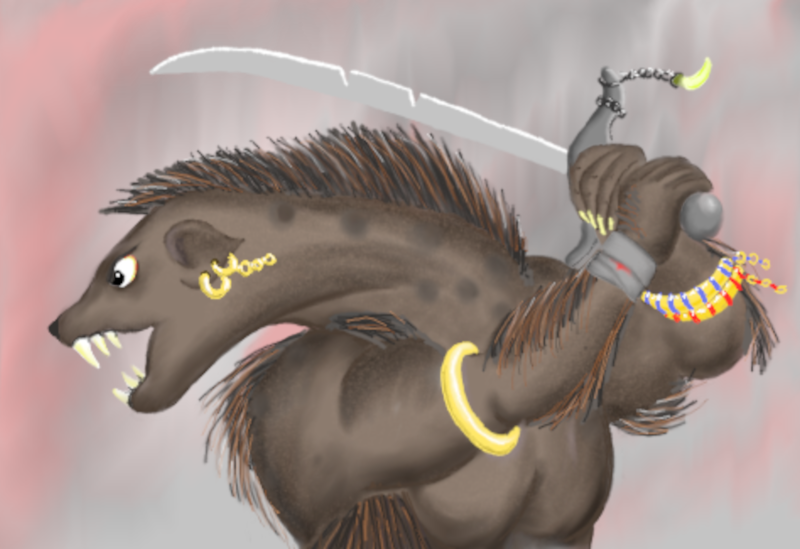
Likewise, different breeds of Gnoll have slightly different builds and facial features, although this is a lot less varied than dogs. Specifically, facially most Gnolls resemble Hyenas, although some have narrower faces and longer snouts like Wolves. Tails are thick and whip-like or bushy.
Due to the structure of their throat, Gnolls tend to have growly, snarly voices at a low pitch, whether male or female, and all can howl or whine when they wish to. All have large erect ears and wide noses with large nostrils, giving them excellent senses of smell and hearing. Sight is not quite as good as Humans but better in low-light conditions. Gnolls do not have Infravision.
The hands and feet of Gnolls are not as flexible as Humans but still able to grip strongly. This means they are less adept at crafts and such but can still use weapons as long as the grip is thick enough for them. They can handle large bows, but short bows and crossbows are too fiddly for them to work properly. Most weapons are large and impressive. They do not seem to like shields and have a preference for two-handed weapons, but whether this is physical limitations or merely aesthetic is unknown.
While tall, they rarely stand completely erect and tend to lean forwards, balancing on the balls of their feet. Their heel is further up the ankle than a Human and doesn’t normally contact the ground when walking or running.
Gnolls can increase their movement to 160ft by dropping to all-fours and running. They rarely do this, however, as it prevents them from carrying things properly. With some tribes this is also a shameless display of primitive behaviour. More serious than a Human picking their nose or even playing with themselves in public.
Geography and Habitat
Gnolls can be encountered in most climates, different breeds being adapted to their local environment in terms of thicker and longer hair, larger or smaller ears, larger mouths and tongues, for panting, and thicker or thinner builds. None of this variation affects their basic stat-blocks any more than normal individual variation would.
While Gnolls can be found anywhere on the surface world, they are most abundant, and dominant, in wide plains and forests, specifically the Dog Wastes on the Upper World, which is named for them. They are not sailors, although all can swim and often love being in the water, so they are rare on remote islands.
Gnolls are known in the Darkworld but usually limited to the upper layers with access to the surface. They are very rare any deeper than a hundred feet or so underground unless in the employ of a powerful subterranean creature and supplied with a useful light source.
Diet
Similar to dogs, Gnolls are omnivorous as regards some foods but are primarily Carnivores. They have a great tolerance for corrupted food and can stomach rotten meat and even animal waste if they need to. As regards the types of meat they will eat, this may be anything. They regard all other animals as potential food, including other Packs in times of need and certainly the young of other families, perhaps even in the same Pack.
They tend to avoid fruit but will eat a variety of vegetables and many types of Thaumofungus, although the latter out of necessity rather than preference.
Gnolls enjoy beer and wine and can even produce their own, especially cider where the local climate allows it. Drunkenness amongst some Gnoll tribes is common and very disruptive.
Social Structure and Alignment Preferences
Gnolls are pack animals and will be associated with a specific pack for their whole life. While individuals may move from pack to pack, particularly males, a deep loyalty to their original pack will usually over-rule their current position. Gnoll society is based around a very strict pecking order which will determine all their organisational decisions. This hierarchy is constantly changing as individuals gain and lose standing within the tribal group, but the whole will always present a united front to outsiders, at least initially.
All Gnolls regard any creature not of their own pack as potential food or a potential threat, which makes all their interactions with other species almost uniformly violent. They will use any tactic that is expedient to preserve their own lives and the existence of the pack, but other individuals, even in the pack, are never anything but a threat. They will make promises and oaths if required but will not keep them except where the welfare of the pack is involved.
As a result, the society is Lawful Evil, placing the welfare of the Tribe, or Pack, above all other considerations except personal welfare. Individuals tend to be more Neutral in their outlook, sometimes even Chaotic, although this is rare. Lawful individuals tend to prevail in the more senior structures of the packs, as they command more respect due to being more trustworthy, and when Packs combine in times of dire need the selected leaders will almost certainly be strongly lawful.
Apart from in senior leadership, which is usually but not always male, there is little distinction between males and females in terms of fighting ability and pack duties. Although they are easy enough to tell apart, their stat-blocks are the same and they can rise to any rank within the Pack. The predominance of males in the upper hierarchy is more due to breeding requirements than physical or mental ability.
Packs of Gnolls are often employed by other powers, mainly as mercenaries or hunters. They do not make good guards nor escorts, due to their lack of focus, but can be very effective raiders and marauders if well controlled and inspired.
Religion and Spirituality
The majority of Gnoll Packs follow a spirituality based upon powerful Gnoll gods running in a ferocious celestial pack. It is believed that successful warriors killed in combat may be invited to join this pack when they die, otherwise they will go to the Endless Prairie, where they will run with their ancestors forever.
Spirituality is based around the shared experience of the Pack, and all the members of the pack will be initiated into this partnership at an early age, usually with some second ceremony to confirm adulthood. There is a strong belief in the invisible link between the Pack Members and many of their stories and legends feature Telepathy-like abilities to communicate with other Pack members. Although never observed, there is a belief amongst Gnolls that the perfect Pack will spontaneously develop this ability or have it conferred on them by a member of the Celestial Pack.
Not all Gnolls follow this religion, which in itself varies hugely in terms of rituals and god names. Many Gnolls will follow the deities and belief systems of any races that control them or demand it. Gnolls are not particularly spiritual creatures and there are few Shamen.
Reproduction and Family
The Pack will consist of 2d6 families of 4d12 individuals each, which breed outside the family but within the pack if they can. The usual lifestyle is nomadic, with the families travelling around the Pack territory, meeting the other families as they move. A Family on the move will carry its equipment with it and the Gnolls of the Dog Wastes use tall, conical tents like teepees as the heart of their camp. A lot of Gnolls sleep outside and some Packs have no form of accommodation at all. Meat is eaten raw so camps will very rarely have campfires. A Gnoll family will move about 2d10 miles a day looking for food but will stay within a wider Pack territory. If the territory is violated by other Gnolls or a similar threat, the families will unite into a pack before attacking. If the threat is obviously beyond the power of the Gnolls they will avoid it, perhaps leaving scouts at a safe distance to maintain security.
Males and sometimes females will move between packs for various reasons and most Gnolls mate for life. While there are strong ties of loyalty within the pack and to related packs, other packs are usually treated with hostility or neutrality at best. Overall, anything outside that limited spread is an enemy or prey, usually both. Individual Gnolls from outside this group will be treated as badly as one can imagine.
Gnoll females come into season for one week a month but once they have had some pups they will not come into season again for 2 years. Gestation is 8 months and a litter will be 1d4 pups. Pups are mobile when born but mentally the level of dogs. They ween within 6-7 months and walk upright at about the same time. They are capable of fighting from 3 years old (treat as kobolds in terms of physics power) and are considered adults and fully grown at 12 years. Growing Gnolls need a lot of meat.
Young males will often be entrusted with the care and training of older pups while younger pups will be cared for by their mothers and their mother’s close relations. Once adults, at 12, the individual becomes responsible for managing their own position in the pack pecking order – no preference is given to the offspring of the current pack leader, although genetics tend to play a significant part here. A Pack Leader will always be a powerful physical specimen, and such traits are usually inherited.
Weapons, Armour and Equipment
Gnolls are not known to manufacture their own metal items. They all seem able to work wood and have excellent fieldcraft skills, but only some Packs, of the less nomadic type, have mastered Leather production. As they can work wood most are able to manufacture longbows and spears and most of the pack will be equipped with these. Spear and arrowheads may be flint, sharpened bone or metal if the Gnolls can obtain it. Many of the Packs in the Dog Wastes can work Bronze but are rarely in one place long enough to produce their own.
They are able to repair tools and armour, where such technology is within their grasp, so once they have obtained suitable weapons, they will last a long time.
Otherwise, all weapons and tools will be stolen or taken from victims. Gnolls often use their loot to buy weapons and such from more powerful and technologically able societies. Some Human groups in the Wild Lands are known to trade with Gnolls, as do some Dwarves, Orcs, Goblins and the like, but not Elves other than Deep Elves.
For this reason, most Gnoll equipment will have a variety of origins. Magical items will be treasured heirlooms.
Gnolls dislike shields and metal plate armour. Their normal Armour Class is based on wearing leather or furs, anything better than this will improve their AC. Chainmail is a particularly prized resource but one that the Gnolls struggle to get to fit and are unable to repair or adapt.
Special Tactics and Strategies
Gnolls hunt in packs, selecting weaker individuals and less powerful foes. The search for food is their main motivation, although they will attack for treasure or equipment they can see a use for. In times of plenty Gnolls will rarely attack but will follow intruders in their territory to make sure they don’t do any harm.
They have no specific war tactics, other than nighttime hit and run attacks, but have excellent hunting and tracking skills. They will often pursue their quarry for huge distances at speed, to exhaust them or separate out individuals or smaller groups before the Gnolls attack.
They can be taught small unit tactics, but their Pack mentality prevents organisation on any larger scale than about a hundred individual warriors.
There are many instances in recorded history where different races have tried to gain the loyalty of large groups of Gnolls or even train them up as infantry, but these efforts seem to be in vain. There are also many tales of other races, particularly Evil Humans, raising Gnolls from pups in an effort to employ them as soldiers but, again, this rarely succeeds beyond the loyalty of a few individuals who might be used as bodyguards or some such.
As Gnolls are large, 2 Hit Dice creatures they do make a powerful enemy and will dominate most other Humanoid groups they are made to work with, but they are selfish, arrogant and vicious creatures who do not make good allies. For a Gnoll, today’s ally is tomorrow’s dinner.
Stories of adventurers throwing sticks to distract Gnolls are probably untrue.
© Dunromin University Press
If you found this item useful/interesting/fun then you might be interested in our other articles about Humanoids:
Goblins here
Orcs here
Kobolds here
Lizardmen here
Hobgoblins here
More may be added over time…