


Of Lizardmen and Troglodytes
Dated: 27 Aug, 2026
This is the latest in a series of Blog Posts about Humanoids on Barnaynia. While these thoughts need have no real effect on your game, they are here as food for thought, if nothing else….
Physical Appearance (and breeds)
The Old Elvish for Lizardman is Simian Sauropod, which, in this author’s opinion has been mis-translated to Lizardman. They are, in fact, Dinosaurmen. “Dinosaurs” being a collective term for a group of lizard-like creatures who are warm-blooded, as are Lizardmen and Troglodytes. The old Elvish for Troglodyte is also Troglodyte – it seems Common uses the same word probably because the Elves named them first.
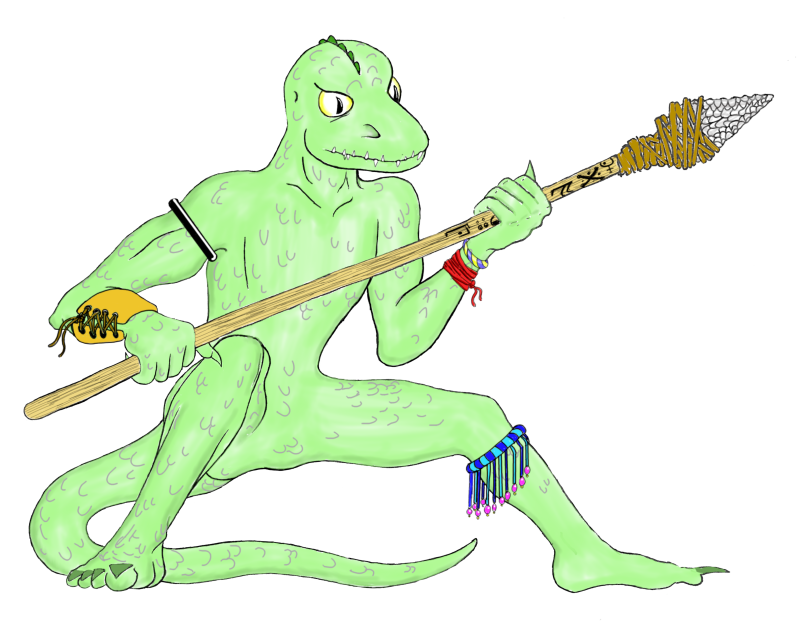
Lizardmen are Lizard-like in appearance with smooth, dry scales, hidden ears and nasal orifices and narrow eyes with oval irises. However, Lizardmen differ from reptiles in that they are warm-blooded, allowing them far greater flexibility in terms of climate survival but increasing their calorific requirements. Troglodytes are similar but may be more closely related to Dragons in that they can Thaumosynthesise as well (produce food from Magical Fields).
Like most vertebrates, they are Tetrapods, but they are bipedal, hence being classed as Humanoids, even though they have a tail. They are not Giantkin. Being bipedal of course means their upper limbs are free for other tasks besides locomotion. So free, in fact, that they do not drop to all-fours to move quicker, like Gnolls can, although they can use all four limbs when swimming.
Lizards are quite amphibious, although they cannot breathe underwater. They prefer fresh water in general although there are many groups that live in saltwater, or perhaps they just don’t mind whichever…
Colouring is basically green but groups from different locations have different shading, browns, greys and mottling. Some males have colourful crests or even bright colours on their bodies. These colourations seem to be a big issue amongst Lizardmen and one of the reasons they have not become a united, larger civilisation is the fierce divisions between the different colourations.
Males are always more colourful than females and definitely larger on average. Otherwise, there is no obvious external differences between the sexes. It is not believed that female Lizardmen have crests but this is not known for a fact.
Adults usually stand between 5 and 7 feet tall but, including the tail, can be as long as 10 feet. The tail is used for balance and swimming primarily, lacking the flexibility to be used as a fifth limb and only being useful as a weapon in dire circumstances.
Troglodytes are similar in most ways, although colouration is darker and the scales are covered in a thin layer of mucus-like material for protection against the harsh edges common in their subterranean habitat. Troglodytes are more uniform in their appearance than Lizardmen and all Troglodytes, males and female, have a head-crest of dark green.
Troglodytes are slightly shorter than Lizardmen, on average, being 5 to 6 feet tall but are wider in the belly. Troglodytes also have much shorter tails which function for balance rather than swimming.
Troglodytes also have Infravision, which Lizardmen do not.
Neither Lizardmen nor Troglodytes seem to like to wear clothes. Both adorn themselves with decorative trinkets, webbing, belts and similar strapping, even headdresses, and they wear jewellery, although more complicated items are shunned in the name of mobility.
Geography and Habitat
Lizardmen prefer damp and swamp-like terrain, or river basins, coastal deltas or lagoons. Their preferred lairs are usually a mix of water and relatively dry passages and rooms. They lay their eggs on land. They are also known to dwell underground, but their lairs are rarely very deep and will always have several access points to the surface, usually concealed underwater.
Troglodytes are entirely subterranean, preferring the deep Darkworld, and lay their eggs in water. Troglodytes rarely venture very near the surface and dislike the light of the sun and the moon, which is surprising given their Thaumosynthetic abilities. Lizardmen and Troglodytes very, very rarely inhabit the same areas but it is not known if this is deliberate avoidance or merely because their preferred habitats are different.
Lizardmen can be found anywhere on the surface of the world that is temperate or warmer. They have been known to wear clothes to visit colder climates but this is only in emergencies and all Lizardmen prefer to be naked. They will often decorate themselves with trinkets or wear belts to carry equipment.
Troglodytes can be found anywhere in the Darkworld, but they do prefer warmer climates. Neither Troglodytes not Lizardmen have ever been encountered in the Shadowlands, nor in the Greywall or the Ripplelands.
Diet
Both Lizardmen and Troglodytes are primarily carnivores but are omnivorous. They both eat meat and fish, the Troglodytes supplementing their diet with Thaumofungus and Thaumosynthesis.
Lizardmen are not known to eat Thaumofungus but do eat a wide variety of plants and fruit. They seem to have no preference when it comes to meat, eating birds, lizards and mammals as well as fish.
Alignment Preferences
Lizardmen are generally classed as Neutral, but this is mainly due to their rather dull intellect. Lizardmen of all alignments have been found but Neutral and Neutral Good (or Neutral Nice) are the most common. They do not seem to be very Chaotic nor Lawful in general.
Troglodytes are generally regarded as being Chaotic Evil (Chaotic Nasty) due to their violent attitudes to all other species, including Lizardmen, and disgusting personal habits. To the knowledge of those in the University of Dunromin, no Troglodyte individuals have ever been observed demonstrating kindness to anything, even other Troglodytes.
Social Structure
The main inspiration for this section is the excellent Saltmarsh series of adventures, U1, U2 and U3, produced by TSR back in the 1980s.
Both Troglodytes and Lizardmen have social structure based around a tribe of a collection of families. Such tribes usually number 60 to 200 individuals and have a pretty flat hierarchy.
With Lizardmen the leader will be an older individual recognised for their intelligence as much as their martial prowess. Lizardmen seem to mate for life, but leaders and powerful male members of the tribe have been known to take all the breeding rights in certain circumstances. Males are larger than females and dominate the society.
With Troglodytes, the chief is selected by martial prowess only and changes often. Only the chief is allowed to mate with the females of the tribe.
Both Troglodytes and Lizardmen value treasure, but for different reasons. Troglodytes use precious things to demonstrate status, whereas Lizardmen use them to trade with other species for equipment they need; specifically metal tools, food and luxury goods.
Lizardmen have integrated quite well with Demi-Humans and Humans and many Human settlements will have Lizardmen living in close proximity, providing fish or other water-based products and services.
Troglodytes are the opposite, being intolerant of all other species under all circumstances.
Religion and Spirituality
Troglodytes seem to have no real spirituality as we would recognise it. They are known to collect in large groups after feeding and exchange conversation and chanting, but this is not known to be religious or social. There are no known examples of Troglodyte Shamen, but they do have Witch Doctors.
Lizardmen have a diverse range of religions, usually based around nature spirits but occasionally closely resembling other religions. Lizardmen tribes of the eastern Land of the Young and across the Wide Sea have a belief system resembling the Babylonian but based around Lizardmen rather than Humans as the dominant species.
Travellers tell of Lizardmen communities in the far east being very large and advanced, and following a very Heliopean set of deities.
Lizardmen tribes will have a number of individuals who have powers Humans associate with Witches and who might even ascend to the rank of Shamen, especially if the tribe has a particular deity they worship.
Reproduction and Family
Lizardmen lay a clutch of 3 to 10 eggs once per year. These are cared for in secret nests shared by families but not by tribes. Once hatched the “newtlings” grow rapidly and are dangerous at 3 years old and adults at 12. The young are cared for in nurseries protected by the whole tribe but family bonds are strongest.
This is because rank is inherited so it is important for individuals to know who their parents were. Couplings resembling marriages are often used to reinforce diplomatic agreements between tribes.
Troglodytes lay a similar number of eggs and have a similar life cycle. Troglodytes to not have a breeding season, however, and may lay at any time.
With Troglodytes the eggs and young are kept is well-protected, often hidden or secret, locations and brought up together by the females. Individuals will identify as being part of the tribe with some close associates but no familial connections.
Weapons, Armour and Equipment
Due to their watery habitats, neither Lizardmen nor Troglodytes have developed any kind of metallurgy, so weapons tend to be stone (flint or obsidian) or obtained from other sources. Stabbing and bludgeoning is preferred, with Troglodytes having only spears as missile weapons.
Lizardmen do use darts as well and can learn to use bows and slings.
Neither species uses armour, other than the occasional helmet or other headdress. Both species have been known to use shields of all types although with a preference for metal and other materials that don’t float.
Special Tactics and Strategies
Lizardmen are very patient ambush predators, seeking to use their amphibious abilities to their advantage as much as possible. When not hunting, they cooperate well and can be taught (or learn) some pretty sophisticated small-unit tactics. They rarely engage in wars except in self-defence but are known the always be hostile to Frog Folk (Bullywugs) and evil aquatic races, along with anyone that associates with them.
In swamps and similar locations Lizardmen have been known to coordinate small groups to attack and withdraw quickly from different directions, always trying to hit a target’s rear or flank, one after the other. Snares, tripwires and nets are also used to drag targets in armour into the water.
Troglodytes are a lot more aggressive but will generally avoid any combat unless they have at least a 3 to 1 advantage, 5 to 1 if the enemy is equipped with metal armour and weapons. Their tactics will be based on brute force, particularly against those suffering from their pungent special attack. They will try and attack from multiple directions, seeking to drive the enemy apart so their can concentrate attacks on the weakest.
© Dunromin University Press
If you found this item useful/interesting/fun then you might be interested in our other articles about Humanoids:
Goblins here
Orcs here
Kobolds here
Lizardmen here
Hobgoblins here
More may be added over time…